
Start with the official DLTC fees
South African Government guidance does not publish one national learner's licence price. It tells learners to contact their local licensing office for the cost. That matters, because the amount can differ by province, municipality, and testing centre.
For this draft, two Western Cape examples show R68 to make an appointment and R33 for the learner's licence after you pass. George Municipality lists the same R68 application and R33 issue amounts. KwaZulu-Natal Department of Transport lists a prescribed learner-licence fee of R150.
So a practical official-fee planning range is about R101 to R150 before transport, photos, optional private eye testing, or study material. Treat that as a sourced planning range, not a national fixed price.
Add ID photos and the eye test
Official guidance says you need ID photos and an eye test. Some local pages specify two photos. The photo price is not usually part of the official learner-licence fee, so budget for it separately.
- ID photos: a practical private-fee example is R40, but confirm near you before you go.
- Eye test at the DLTC: many learners do the eye test at the testing centre, but still budget time for the queue.
- Private driver's screening: optional examples checked for this draft range from R100 at Spec-Savers to R200 at Dynamic Vision.
For a simple budget, allow about R40 for photos and R0 to R200 for the eye-test route. If your DLTC can do the eye test on site, do not spend on a private screening only because someone told you to. Confirm what your centre accepts first.
Choose your study material deliberately
The cheapest study route is free: NaTIS provides learner-driver manual sections for Rules of the Road, Road Traffic Signs, and Vehicle Controls.
Free manuals are useful because they are source material. The downside is that you must build your own study plan, quiz yourself, track weak areas, and keep going when the PDF feels heavy.
A paid K53 book or ebook can help if you like reading from one organised guide. Current retail examples checked for this draft show The Official K53 Learner's and Driver's Made Easy at about R55 to R58 as an ebook. Printed books or manuals can cost more depending on the shop and delivery. A fair planning number for a book or ebook is about R60 to R125 before delivery.
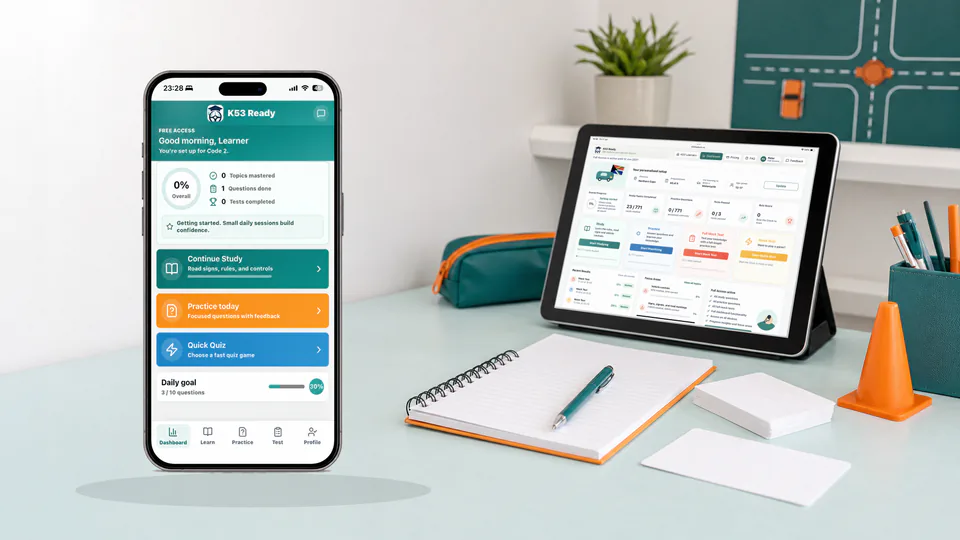
K53 Ready fits into the same low-cost preparation category. Full Access is R79 once-off for 1 year. It gives you phone-based study, practice questions, mock-test style revision, progress tracking, Quick Quiz, and wrong-answer review whenever you have a few minutes.
Build a first-time pass budget
Because fees vary, do not treat one total as official. But if you want a planning number before you book, start here:
- Lean route: official fees of about R101 to R150 + photos around R40 + free manuals = about R141 to R190 before transport.
- Book route: add one ebook or book at about R60 to R125 = about R201 to R315 before transport.
- K53 Ready route: add R79 Full Access to the official-fee and photo estimate = about R220 to R269 before transport.
- Private eye-test route: add about R100 to R200 on top of whichever preparation route you choose, if you decide to do that before going to the DLTC.
A sensible planning average for a learner who wants structured preparation is around R250 to R350 before transport and missed-time costs. You can spend less if you use only free manuals and the DLTC eye test. You can spend more if your local fees, photos, private screening, delivery, or transport are higher.
Do not forget the time cost
Time is the hidden cost. You may need time to confirm the booking route, travel to the DLTC, queue, complete the eye test, write the test, and pay the issue fee if you pass. Western Cape guidance tells learners to arrive 15 minutes before the test time, but that is only the arrival buffer, not the full visit.
If you miss or cancel an appointment, Western Cape guidance says the appointment payment is not refunded. If you fail, you may need to book again, pay again depending on your centre, travel again, and give up more time. That is why preparation has financial value even when the study tool itself is cheap.
Keep a simple schedule: confirm your fee and photo requirements, choose your study material, practise weak areas, and only write when your practice sessions feel steady.
A practical way to spend
If your budget is tight, do not buy everything. Spend on the pieces that help you arrive prepared.
- Download the free official NaTIS manuals for source detail.
- Use one structured study tool, either K53 Ready or one good book, so you are not bouncing between random materials.
- Keep money aside for official fees, ID photos, transport, and any eye-test choice.
- Use practice sessions to reduce the chance of paying twice.
The goal is not to spend the most. It is to arrive with the right documents, the right fee for your DLTC, and enough practice behind you that the test does not feel like your first real attempt.