Your learner's licence only covers one vehicle category
The Department of Transport says learner's licences are issued for different categories of vehicle. Code 1 covers motorcycles, Code 2 covers light motor vehicles up to 3 500 kg, and Code 3 covers heavier vehicles above 3 500 kg.
That means your learner's licence is not a general permission to drive anything. Stay with the vehicle type that matches the code you passed for, and prepare with the matching controls content as well as the shared signs and rules sections.
Supervision is the default rule
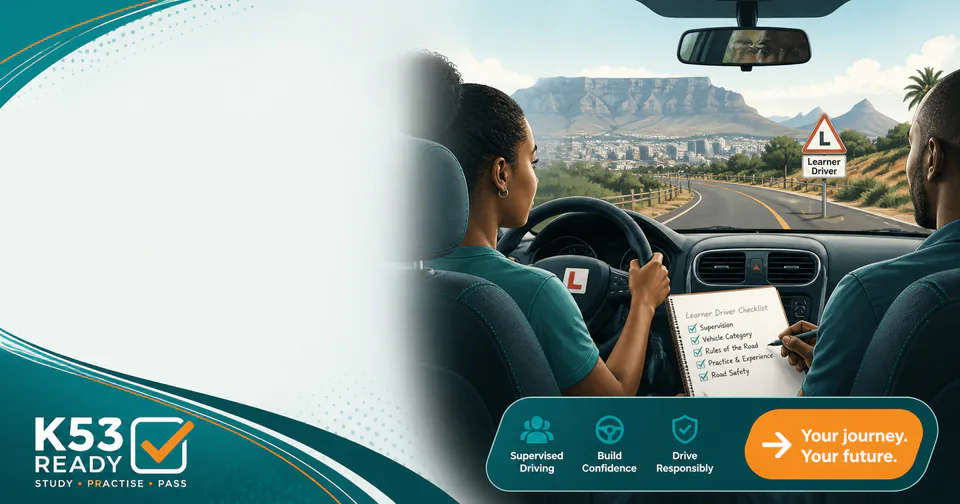
The Department of Transport states that a learner may drive only while supervised by a licensed driver. If the vehicle category needs a professional driving permit, the supervising driver must also hold that permit.
For most learners this means you should not plan solo practice trips. Before you leave, make sure the person supervising you is licensed for that vehicle category and understands that the learner driver still needs support with safe, lawful driving decisions.
Motorcycles have a different exception
Western Cape Government guidance explains the main exception clearly: a licensed driver must accompany you at all times except on a motorcycle. The same guidance also says a learner driver may not carry another person on a motorcycle.
If you are learning on a motorcycle, do not treat the exception as a licence to ignore the rest of the rules. The learner's licence still applies only to the relevant motorcycle category, and you should stay conservative about where and when you practise.
The learner's licence is temporary
The Department of Transport says a learner's licence is valid for 24 months and cannot be extended. Western Cape Government guidance also states that the learner's licence is valid for 2 years.
Use that time deliberately. Build a routine that covers road signs, rules of the road, and vehicle controls, then move toward supervised on-road practice and your driving-licence booking instead of waiting until the last minute.
A learner's licence is not the same as a driving licence
The South African Government driving-licence guidance says you need a driving licence to drive legally on South African roads and that you must have a learner's licence before applying for a driving licence.
In practice, the learner's licence is the preparation stage. It proves basic knowledge and lets you begin lawful practice within the learner rules, but it does not replace the later driving test, booking process, or licence issue steps.
Use official local checks before every important step
National guidance gives the core rule set, but local centres can still control booking routes, appointment handling, accepted proof of address, and other admin details. That is why it is worth checking your local DLTC or official booking route before each milestone.
K53 Ready can help you study and practise consistently, but final legal requirements, bookings, and issuing are still handled through official transport and licensing channels.