Notice the crossing warning early
The NaTIS road-signs manual uses the railway-crossing warning sign (W318) to tell you that tracks are ahead. Its learner action is to slow down, look both ways for a train, and stop in time if one is approaching. A gate or boom warning (W314) tells you to prepare to stop if the gate is closing or closed.
The road-signs manual also shows signs at the crossing itself. The Department of Transport's traffic-sign manual describes W403 for a single railway line and W404 for more than one line. Do not rely on one familiar picture: recognise the place and the action it asks of you.
Obey the stop sign, flashing red lights, and boom
A STOP sign means stop at the proper place and check before proceeding. At a crossing, flashing red disc lights tell a driver to stop and not continue until it is safe; the Department of Transport says they have the same significance as a STOP sign.
Never drive around a lowered boom. Even if you have waited and cannot see a train, stay behind the barrier and obey the signals. Government rail-safety advice also tells drivers to look both ways and listen for a train.
Make sure there is room beyond the tracks
Before you move, look at the road on the far side. If traffic has stopped there, wait before the crossing so your whole vehicle can clear the tracks in one movement. A green gap directly in front of you is not enough when the exit is blocked.
The Department of Transport explains that stopping on the roadway within the railway reserve is prohibited except to avoid an accident or when a sign or traffic officer directs you. Treat the tracks as a place to pass through, never as a waiting space.
If a vehicle stalls on the tracks, get clear
If a vehicle becomes stuck on the tracks, get everyone out and away from the railway line immediately. Government safety guidance says to call the police for assistance. Do not stay in the vehicle trying to solve the problem while people are in danger.
This is an emergency plan to remember, not a reason to rush an ordinary crossing. The safer everyday habit is to check the exit before entering.
Practise the decision while safely parked
Before your next supervised drive, try this short routine with your licensed supervisor while the vehicle is stationary:
- Spot: which warning sign tells you a crossing is ahead?
- Read: is there a STOP sign, flashing red light, or closed boom?
- Look: can you check both directions for a train?
- Plan: is there enough clear space beyond the tracks for the entire vehicle?
- Decide: if any part is uncertain, where will you wait safely?
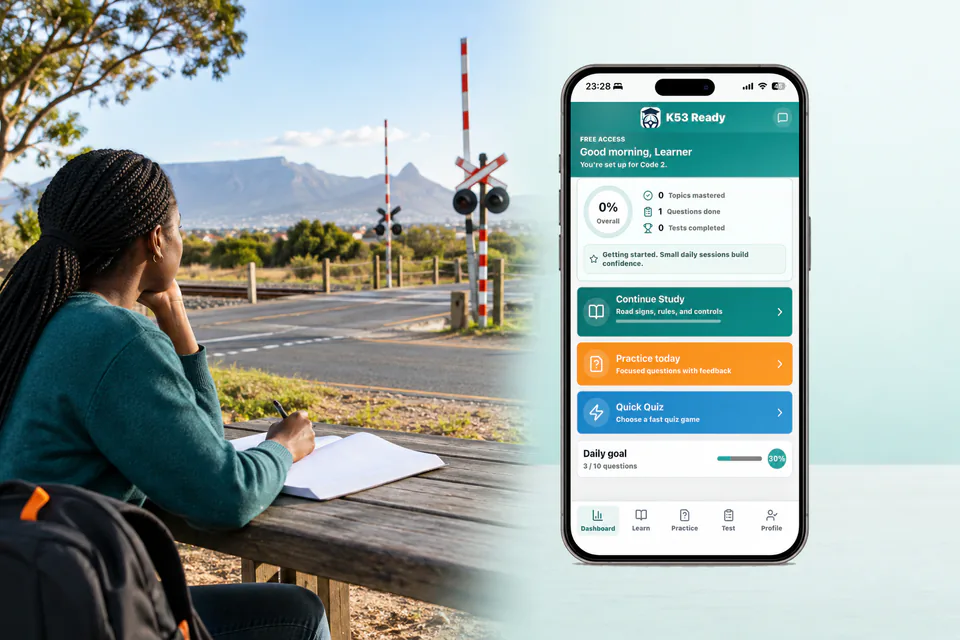
Use K53 Ready to practise road signs and rules in a small study session, then explain the action behind each answer in your own words. Put the app away before the drive; keep your attention on the road and your supervisor's directions.