
Remember the three general limits
The official NaTIS learner manual gives these general limits unless a road traffic sign indicates otherwise: 60 km/h on a public road in an urban area, 100 km/h on a public road outside an urban area that is not a freeway, and 120 km/h on a freeway.
A simple memory cue is town, open road, freeway: 60, 100, 120. Say the road type as well as the number. That helps you avoid applying the freeway limit to an ordinary road outside town.
Let a posted speed-limit sign lead
The Department of Transport's road-sign manual says the red-bordered R201 speed-limit sign sets the maximum speed shown on it in kilometres per hour beyond the sign. If you see a posted limit, use that number for the road ahead instead of relying on the general limit you remembered.
When you move from one road to another, look again. A familiar area can have a different posted limit, and a temporary sign can change what applies during roadworks. Do not guess a new limit from the road's appearance alone.
Separate the legal ceiling from a safe choice
The number on a sign tells you the maximum permitted speed. It does not promise that travelling at that speed is safe in every situation. Rain, poor light, people near the road, bends and busy traffic all deserve more time and space.
Before a supervised drive, ask your licensed supervisor to talk through one example: what is the limit here, and what conditions would make us drive slower? Keep the discussion short and save the phone-based practice for when you are parked.
Check the vehicle and route before assuming
The NaTIS manual also lists special limits for some vehicle classes, including buses, minibuses and heavy goods vehicles. The familiar 60, 100 and 120 sequence is a useful learner starting point, but it is not a complete answer for every vehicle.
If a practice question names a particular vehicle or shows a posted sign, read those details first. Work out which rule the question is testing before you choose a number.
Try a five-minute sign routine
While safely parked, sketch three short routes: a street in town, a road outside town, and a freeway. For each route, work through these checks:
- Name the road type and say its general limit.
- Add a red-bordered speed-limit sign and say which number now applies beyond it.
- Add rain or poor visibility and explain why a lower speed may be safer.
- Change the vehicle in the question and check whether a special class limit matters.
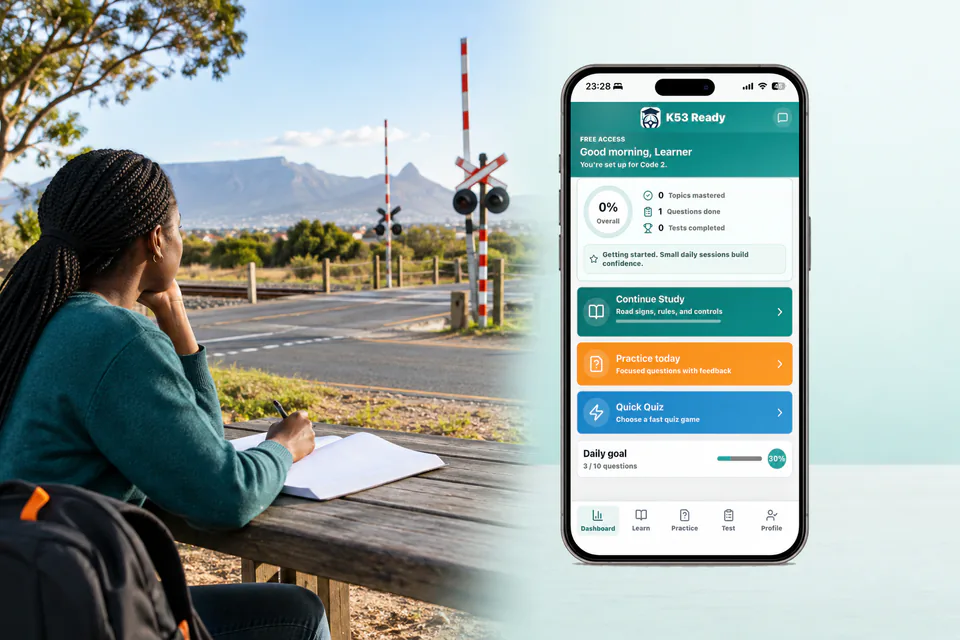
Then try a few K53 Ready rules and signs questions. Explain each answer in your own words, especially when the posted sign and the general limit differ. Put the app away before the vehicle moves.