Look for the person controlling traffic
A traffic officer may direct vehicles when a junction is congested, after an accident, or when normal traffic lights are not working. The NaTIS manual calls these control hand signals SS1. Focus on the officer's instruction for your approach, even when a traffic light shows something different.
Give yourself time to see the whole gesture. An arm position seen for a split second can be easy to misread, especially when other vehicles are moving.
Know when the signal means stop
The official manuals show stop signals for traffic approaching an officer from the front, from the rear, or from both directions. Your job is to identify which stream of traffic the officer is stopping, then wait in your lane.
The Department of Transport's signs manual adds a useful detail: after giving a stop signal, an officer may lower that hand to make another gesture. Traffic already stopped must wait until the officer directs it to proceed. Do not treat a lowered arm alone as permission to go.
Read proceed as permission, then check the road
A proceed gesture tells the traffic stream being directed that it may move. Check that it applies to your approach and planned movement. Then look for people crossing, vehicles still clearing the junction, and a safe path ahead.
If the gesture is unclear from where you sit, stay stopped and watch for a clear instruction. Guessing from the movement of a car beside you is a poor substitute for reading the officer yourself.
Treat roadwork flags as instructions too
The NaTIS manual also covers stop and proceed flags, called SS2. A stop flag means stop and wait for the proceed flag. These signals can be used at roadworks or when animals are being led across or next to a road.
A warning flag asks road users to proceed slowly and stay alert. Slow down early, watch the person giving the signal, and allow for workers, animals or a changed traffic path ahead.
Practise one simple junction routine
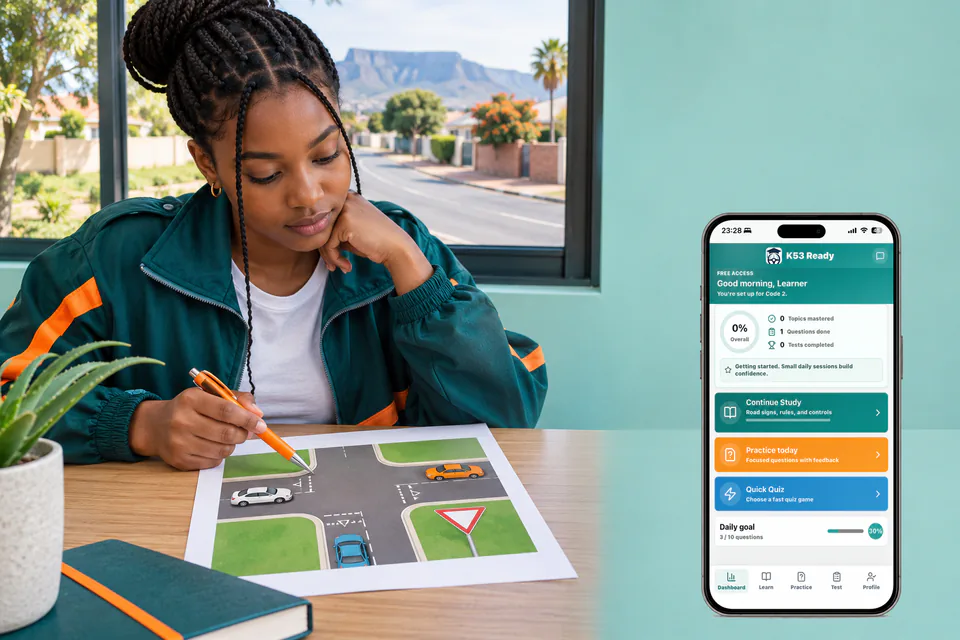
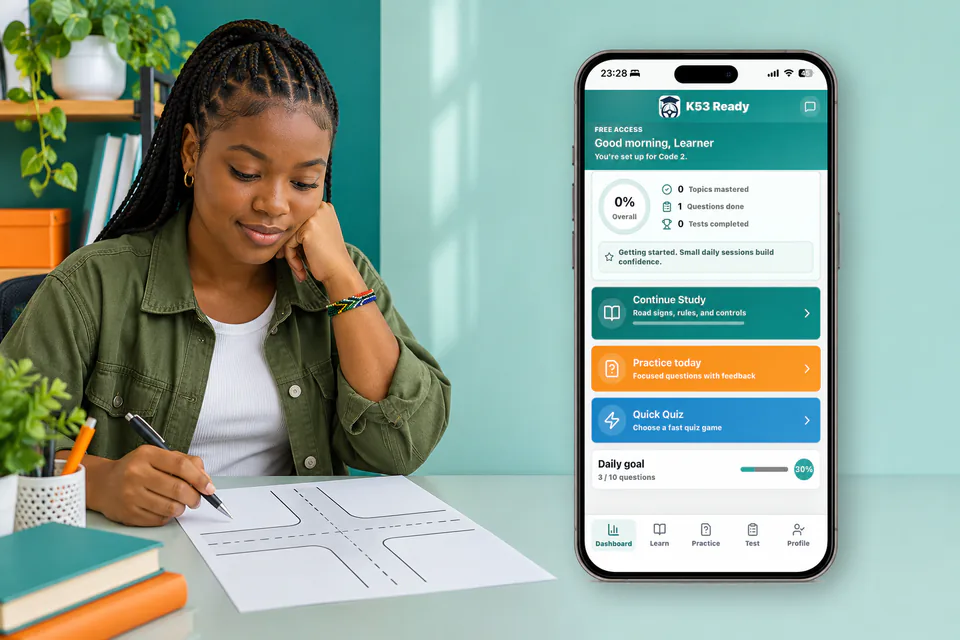
While parked, draw a junction and place a small dot for an officer in the middle. Talk through each approach with your supervisor:
- Who is directing my lane: the officer, a flagger, or a traffic light?
- Is my approach being told to stop or to proceed?
- If I was stopped, have I received a clear proceed instruction?
- Is the crossing and my exit path clear before I move?
Then try a few K53 Ready road-sign and rules questions. Explain the action in plain words, rather than memorising an arm shape alone. Put the app away before the vehicle moves.