
Start with four study areas
Write these four headings on a page or in your phone notes:
- Road signs
- Road markings
- Rules of the road
- Vehicle controls
That is your basic study map. Every time you practise, ask which area you are working on. If you only do random quizzes, you might feel busy without noticing that one section is still weak.
Learn signs by asking what they want you to do
Do not only memorise what a sign looks like. Ask what it is telling the driver.
Is it warning you about something ahead? Is it giving an instruction? Is it guiding you toward a place or lane? Once you start thinking like that, signs become easier to group and remember.
A useful habit is to look at real signs when you are travelling. If you are in a car, taxi, bus, or walking near the road, pick one sign and explain it in plain language.
Do not leave road markings until the end
Road markings are easy to ignore because they do not always feel as obvious as road signs. But they matter. They tell drivers where to stop, where to turn, which lane to use, and when extra care is needed.
When you revise road markings, focus on the ones that affect a driver's next move:
- Stop lines
- Yield markings
- Lane arrows
- Pedestrian crossings
- Solid and broken lines
- Turning lanes
If you can read markings quickly, you are not only studying for a test. You are learning to read the road.
Turn rules into everyday situations
Rules of the road can sound dry when they are written as lists. Make them more useful by turning them into real situations.
For example, ask yourself:
- Who should go first here?
- When must I wait?
- When is it unsafe to overtake?
- How much space should I leave?
- What should I do if someone is crossing or turning?
This makes practice questions easier because you are not just trying to remember words. You are learning the decision behind the rule.
Give vehicle controls a short daily slot
Vehicle controls are part of the official study areas, but many learners leave them for last. That usually makes them feel harder than they need to be.
Give controls a short daily slot. You do not need a long session. Spend a few minutes checking what each control does, when it is used, and why it matters for safe driving. Small repeats work better than one stressed revision session the night before the test.
Use a simple study loop
A practical routine is:
- Learn one small topic.
- Do a few practice questions.
- Check what you got wrong.
- Go back to that topic.
- Try again tomorrow.
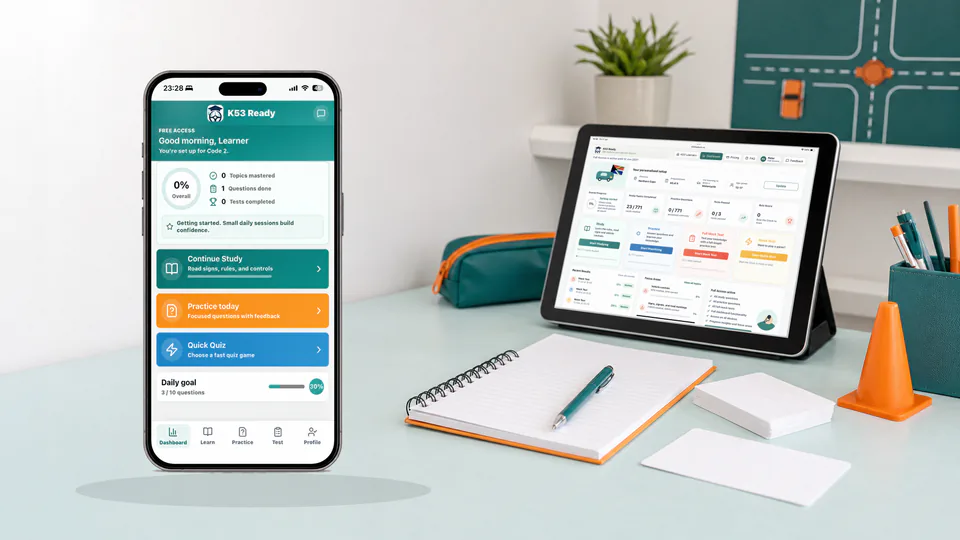
K53 Ready is useful for this kind of loop because it helps you move between study, practice, and mock-test preparation. Still use official sources for final rules, bookings, and requirements.
You do not need to study everything perfectly in one day. Start with the four main areas, keep the sessions short, and pay attention to the mistakes you repeat. That is where your next bit of progress usually is.