Know what the four-way stop sign means
The NaTIS road-signs learner manual calls the four-way stop sign R1.4. It controls all four approaches to an intersection. A three-way stop sign, R1.3, uses the same idea at a junction with three approaches.
Read the whole sign before you decide what to do. An ordinary STOP sign on your approach does not automatically mean traffic on every other approach also has one. Look at the junction in front of you, not just the sign beside your window.
Stop at the right place
Bring the vehicle to a complete standstill behind the stop line. If there is no stop line, the NaTIS manual says the front of the vehicle should stop in line with the sign. Rolling slowly through is still moving; give yourself a clear pause.
Once stopped, look across the junction and along each approach. Check for people crossing and for vehicles already moving through. The next decision is about both turn order and whether the way is actually clear.
Let earlier arrivals clear first
The NaTIS manual says that when more than one vehicle stops at a four-way stop, the vehicle that stopped first should move off first. The Department of Transport's traffic-sign manual makes the crossing-path point more precise: wait for an earlier vehicle whose path would cross yours to clear the junction.
Try to remember the order in which vehicles reached a full stop, not the order in which they started creeping forward. If you lose track, pause and reassess. Do not force your way into the intersection to settle an uncertain turn.
Keep the safety check even when it is your turn
Being next in line is not a promise that the intersection is clear. Before moving, look again for a vehicle that has not stopped, someone crossing, or a blocked exit. Proceed only when it is safe.
If two vehicles seem to stop together, do not guess that the other driver will wait. Pause, check the paths through the junction, and move only when it is safe. Follow any traffic officer's direction and your licensed supervisor's guidance during practice.
Practise the decision while parked
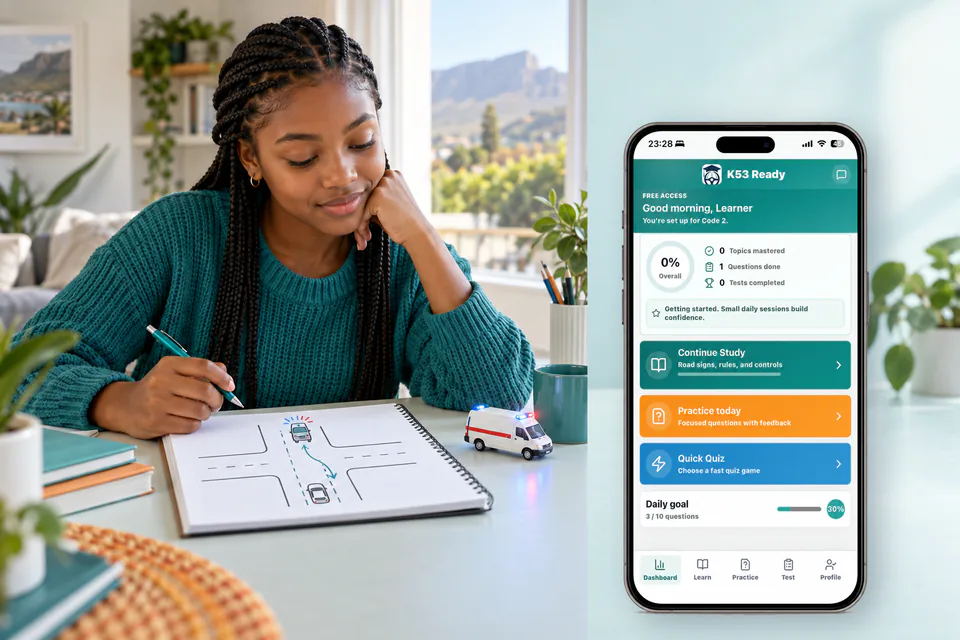
Before your next supervised drive, draw a four-way stop on paper and put four small objects on the approaches. Move them into the junction one at a time:
- Stop: where is the stop line, or where would the front of your vehicle stop if there is none?
- Notice: which vehicle came to a complete stop first?
- Compare: would that vehicle's path cross yours?
- Look: is a person crossing or a vehicle still inside the junction?
- Decide: can you move now, or should you wait and check again?
Use K53 Ready for a short road-signs and rules practice session, then explain the reason behind each answer in your own words. Keep the app away during the drive; your attention belongs on the road and your supervisor's directions.