Read the warning before you reach the crossing
The pedestrian-crossing warning sign (W306) tells you a marked crossing is ahead. Slow down and look for people waiting to cross. The NaTIS signs manual says to stop when a pedestrian is waiting there.
Try this while studying: cover the explanation under a sign and say what you would do next. Naming the sign is useful; knowing the action is the part you need on the road.
Match the markings to pedestrian priority
The yield-to-pedestrians sign (R2.1), pedestrian crossing lines (RTM3), and block pedestrian crossing markings (RTM4) tell you to give priority to people crossing or wanting to cross. Be ready to slow down or stop.
Do not treat the painted crossing as decoration. Look at both ends of it, as well as the road immediately in front of your vehicle. Someone may be about to step out from the side you checked first.
Understand the rule at a crossing without signals
Regulation 315 says to yield, slowing or stopping as needed, to someone crossing within the crossing on your half of the road. It also covers a person coming from the opposite half who is close enough to be in danger.
That is not a reason to squeeze past. Give the person time and space, and check that the way is clear before moving. A pedestrian must not suddenly step into the path of a vehicle that is too close to yield, but you still need to watch for unexpected movement.
Never pass a vehicle stopped for pedestrians
If another vehicle has stopped at a pedestrian crossing to let people cross, Regulation 315 prohibits a driver approaching from behind from passing it. You do not need to see the pedestrian first for this rule to matter.
Think of the stopped vehicle as a blocked view, not an invitation to use the next lane. A person may appear from its front edge just as you draw alongside.
Keep checking at lights and near schools
At a signal-controlled crossing, pedestrians must follow the pedestrian signals. As a driver, follow the signals applying to you and keep looking for people when you turn. A green light does not remove the need to check your path.
The Western Cape Mobility Department advises drivers to reduce speed where many people walk, pay extra attention in low light, and check for pedestrians when turning, reversing, or leaving a driveway. Put the phone away while driving.
Around schools, do not assume a child will wait or behave like an adult. The NaTIS scholar-patrol warning tells you to slow down and look for the patrol stop sign; obey it when displayed.
Use a short study-and-practice routine
Before your next supervised drive, talk through a crossing example while safely parked:
- Notice: which sign or marking first tells you a crossing is ahead?
- Look: where could a waiting person be hidden?
- Decide: what would make you slow down or stop?
- Wait: if a vehicle has stopped for pedestrians, explain why you cannot pass it.
- Review: after the drive, write down the one decision you found difficult and revisit it in the official manual.
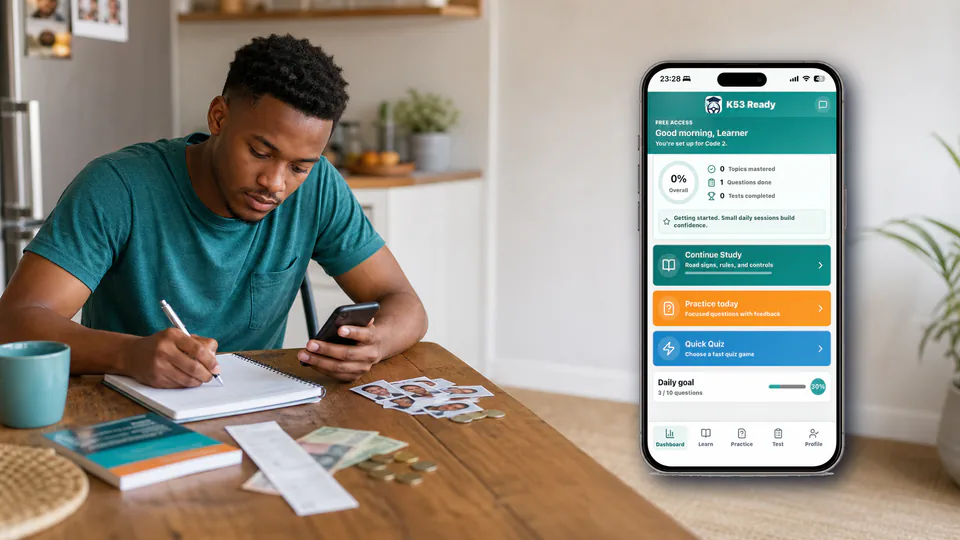
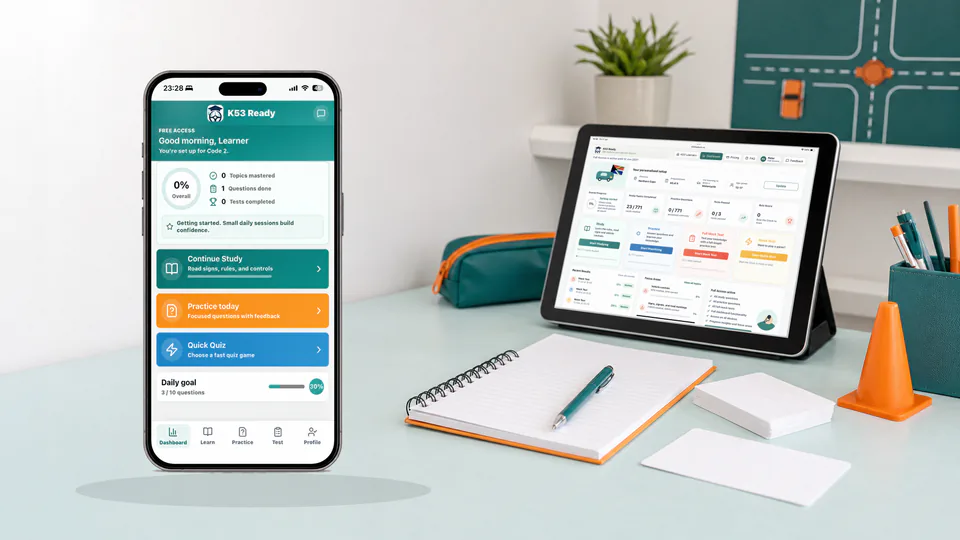
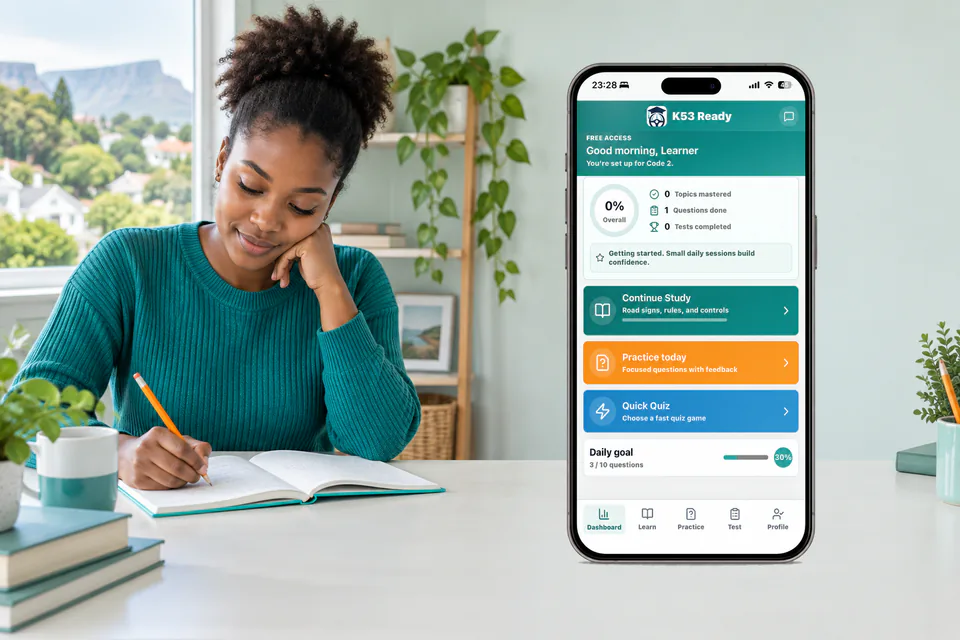
For a small study session, pair a few road-sign questions with rules-of-the-road practice in K53 Ready. Explain each answer in your own words before moving on. Keep the app and these notes for when you are safely stationary; your attention belongs on the road during the drive.