
Treat every marking as an instruction, not decoration
Western Cape Government learner guidance includes road markings among the areas you need to study and understand. The official NaTIS learner manual groups markings by what they do: some regulate your movement and others warn you about what is coming next.
A useful study habit is to ask three questions each time: What is the marking called? What is its purpose? What action must I take? That keeps the picture tied to a driving decision instead of becoming a shape you only half remember.
Know what stop, yield, and pedestrian lines ask you to do
These markings can control an intersection even when your attention is drawn to everything else around it:
- Stop line: bring the vehicle to a complete standstill before the line. The NaTIS manual says the line has the same meaning as a stop sign even when no stop sign is present.
- Yield line: give priority to traffic crossing or about to cross your path. You must still give way when the line is present without a yield sign.
- Pedestrian crossing lines: watch for people crossing or wanting to cross, then slow down or stop to give them priority.
Look beyond the paint as you approach. A correct answer in a test is useful, but the real habit is seeing the line early enough to stop or yield smoothly.
Separate dividing, no-overtaking, and no-crossing lines
These lines can sit near the middle of a two-way road, but they do not all carry the same instruction:
- Dividing line: warns that traffic on the other side is moving in the opposite direction. Keep watching for approaching vehicles that may move toward your side.
- No-overtaking line: do not drive any part of your vehicle to the right of the line. The manual allows limited crossing for direct access to or from an entrance, or to pass a stationary obstruction, only when it is safe.
- No-crossing line: the stricter instruction. Do not cross it or drive to its right, except to get around a stationary vehicle or stationary obstruction in the road.
- Channelising line: keeps same-direction traffic in its path at carriageways and intersections. Do not cross it.
For revision, do not reduce all solid-looking lines to 'no overtaking'. Say the full name and the exact action. That is where many similar-looking questions become easier.
Read continuity lines before the lane runs out
A continuity line warns about a break in the continuing road, such as an intersection or off-ramp. If your lane has the line on one side, that lane may soon turn away from the road you are travelling on.
Check your mirrors and blind spot, yield to traffic that needs to change lanes, and choose the correct lane early. The line may soon become a channelising line or painted island, where changing direction is no longer allowed.
Lane-reduction arrows and mandatory-direction arrows give the same practical lesson: read ahead. A calm early lane choice is safer than a late move across a marking you are not allowed to cross.
Do not treat the yellow left-edge line as a spare lane
The left-edge line shows the edge of the road. The NaTIS manual says to avoid driving to its left. It allows this while another vehicle is overtaking only when all of these conditions are met:
- you can do it without endangering yourself, other traffic, pedestrians, or property;
- it is daytime;
- and people and vehicles on the road are clearly visible for at least 150 metres.
You are not forced to move left of the line when being overtaken, and the manual reminds learners that there is very little space there. If your vehicle breaks down, stop as far left of the line as possible and switch on the emergency lights.
A painted island is still a prohibited area
A painted island is not an extra lane, a waiting area, or a shortcut around traffic. The NaTIS manual says not to stop, park, or drive over it.
The listed exceptions are narrow: an instruction from a traffic or police officer, avoiding a collision, or an emergency. The ordinary learner habit is simpler - choose your path before the island begins and stay outside it.
Turn the markings into a short practice routine
Use a small comparison routine instead of trying to learn every page in one sitting:
- Make three columns: what the marking looks like, what it means, and what you must do.
- Compare confusing sets together: dividing versus no-overtaking versus no-crossing, then continuity versus channelising.
- Pair intersection markings: stop line, yield line, and pedestrian crossing.
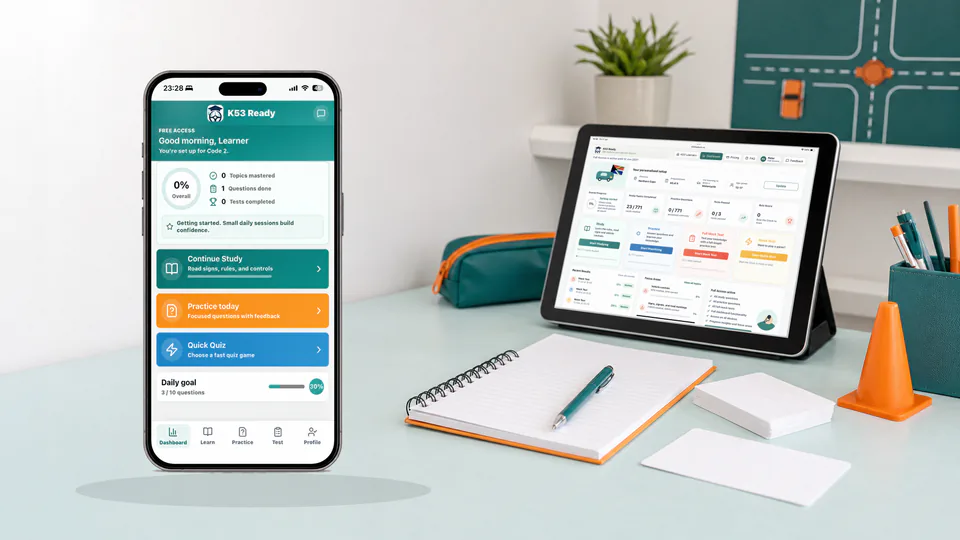
- Use K53 Ready questions to practise recognition, then review why each wrong option is wrong.
- While parked or travelling as a passenger, ask a licensed supervisor to point out real markings. Never look down at notes or a phone while you are driving.
Keep the official NaTIS manual as your source reference. K53 Ready can make the study and practice loop easier, but it does not replace the road signs or the judgement you build through calm supervised driving.