
Slow down before you try to decide
The official NaTIS road-signs manual says the traffic-circle warning sign is your cue to slow down so you can stop if needed or move around the circle at a safe speed. That gives you time to see the vehicles, signs, yield lines, arrows, and people around the junction.
Use a simple approach routine: ease off early, scan every entrance, find the control sign or marking for your approach, and be ready to stop. A rule remembered correctly is useful only if you have first noticed which rule the junction is asking you to use.
Separate a larger traffic circle from a mini-circle
The official learner material describes two common decisions that look similar but are not identical:
- At a traffic circle without a different instruction from a traffic officer, sign, or marking, yield to traffic approaching from your right within the junction.
- The NaTIS manual also reminds you to watch vehicles already in the circle, even when you believe another driver should yield.
- At a mini-circle controlled by the Yield at traffic circle sign, R2.2, the yield lines around the circle become the key reference points.
This is why 'always give way to the right' is too blunt as a study answer. Read the actual sign and road marking on your approach before deciding who should move first.
At an R2.2 mini-circle, compare the yield lines
The NaTIS signs manual says that at an R2.2 mini-circle you must yield to a vehicle already in the circle or to a driver who will cross their entrance yield line before you cross yours. Stop if necessary.
- If another vehicle reaches and will cross its yield line before you, let it proceed when your paths could conflict.
- If you reach your yield line first, do not rush. Check that the other driver is slowing and that your path is genuinely clear.
- If arrivals are very close or another driver's intention is unclear, reduce the risk instead of competing for the gap.
Think 'yield-line order, then conflict check'. The first part helps you understand the control; the second keeps the decision safe in real traffic.
Priority is never permission to force your way through
The Department of Transport's road-signing manual makes an important safety point: a priority rule places duties on drivers; it does not give anyone a right to demand the road. Another driver may be confused, distracted, or already committed to a movement.
Even when the rule appears to favour you, enter only when you can do so safely. Keep looking, leave room for mistakes, and stop rather than turning a small misunderstanding into a collision.
Signal in time and follow the direction shown
The NaTIS learner material says that at a mini-circle you should signal in time, as you would at a normal intersection, to show the direction you plan to turn. The roundabout command sign also tells drivers to move clockwise around the junction.
Signal clearly, but never treat an indicator as a guarantee that another road user will move exactly as expected. Follow the lane arrows and road markings in front of you, avoid a last-second lane change, and keep checking the path you are about to cross.
Scan beyond the cars
Before entering, look for pedestrians near crossings, cyclists, motorcycles, vehicles that may not yield, and anyone already moving through the circle. A small vehicle can be hidden behind a larger one, so one quick glance is not enough.
Keep both hands available for driving and your attention on the junction. Do not look at a phone, notes, or a timer while approaching or moving through a traffic circle.
Practise the decision in three calm steps
Turn the rule into a repeatable study and supervised-driving routine:
- Name the control: larger traffic circle, roundabout command, ordinary yield, or R2.2 mini-circle.
- Say the decision: traffic from the right, traffic already circulating, or the vehicle that will cross its yield line first.
- Add the safety check: slow, signal, scan every entrance and crossing, and enter only when the path is clear.
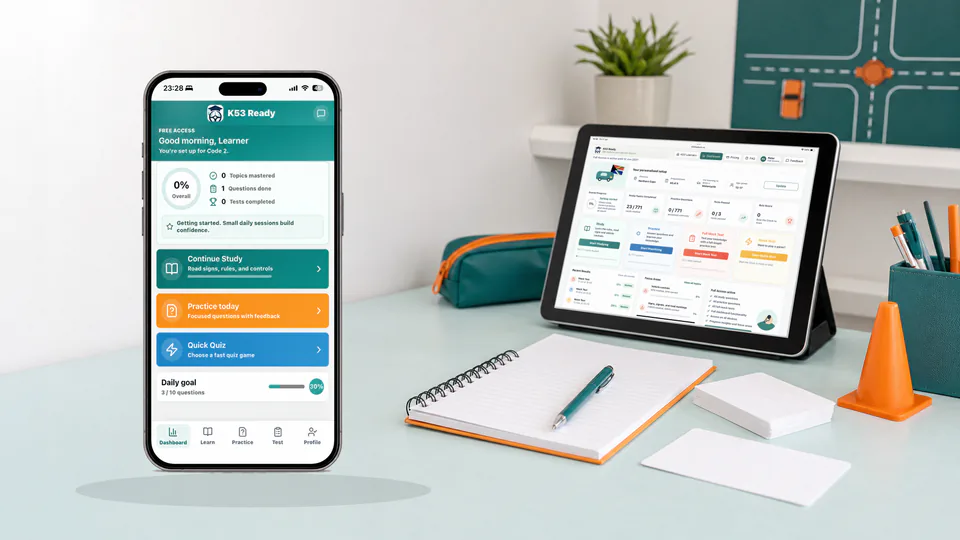
- Use K53 Ready questions to compare similar signs, then return to the official NaTIS manuals when an answer feels uncertain.
- With a licensed supervisor, talk through real examples while parked first. During driving, keep your eyes and attention on the road.
The goal is not to win a race to the circle. It is to recognise the control early, make your intention clear, and choose the safe gap without panic.