
Start with the signal for your movement
Look at the light that controls your approach and the direction you plan to travel. A signal for a turning lane may differ from the light for traffic going straight. Road signs can also restrict a turn even when a light permits movement.
The Department of Transport's traffic-sign manual describes the usual sequence as green, steady yellow, then red. Use that sequence to prepare early, rather than watching the car ahead and reacting at the last moment.
Red means stop; amber usually means stop too
At a steady red light, stop behind the stop line and stay there until a green signal permits your movement and it is safe to continue. Do not creep across the line to get a better view.
A steady amber (yellow) light also asks you to stop behind the line. The exception is when you are already so close that stopping safely is not possible; then you may continue with caution. It is not an invitation to speed up before red appears.
Green allows movement when the way is safe
A steady green light permits you to proceed, subject to signs and other signals. Before you move, check for people or vehicles still lawfully in the junction or crossing. Give them room to clear.
If you are turning, read any separate arrow that applies to your turn. A red or amber arrow can require that turn to wait even while other movements have a green light. A green arrow permits movement in its shown direction; still look at the road before committing.
Treat flashing signals as a different instruction
The official traffic-sign manual describes a flashing red light in its recommended system as an all-way-stop decision: stop, work out the turn order, yield to people crossing your path, and proceed only when safe. Do not treat flashing red as an ordinary green light.
A flashing green arrow permits the movement shown by the arrow. Keep your attention on that direction and check the junction in front of you. Signal layouts can vary, so learn the instruction on the actual signal rather than assuming every junction looks the same.
Practise a calm four-step check
While parked, sketch a junction with a stop line, one traffic light and one turning arrow. For each colour, say the decision aloud:
- Read: which light or arrow controls the movement you want to make?
- Stop: if it is red or amber, where must you wait?
- Look: who is still crossing or clearing the junction?
- Move: when does the signal permit your movement, and is the path actually safe?
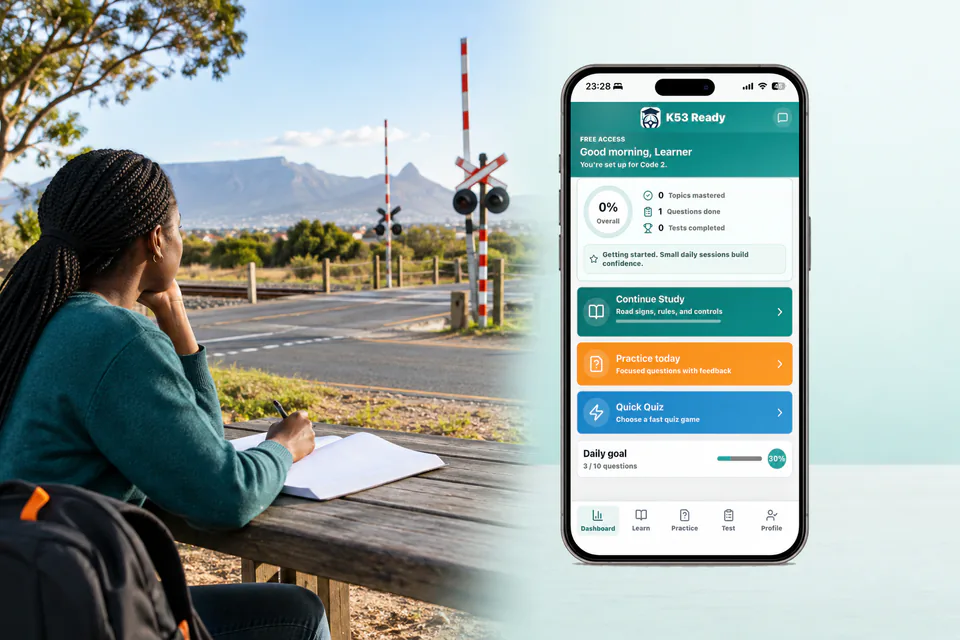
Use a short K53 Ready signs-and-rules practice session to test the same decisions. If you guess an answer, revisit the official signal description and explain it in your own words. Keep the app away during any supervised drive.