
Start with the three pass marks
The official NaTIS testing-centre requirements publish these minimum marks:
- Rules of the road: at least 22 out of 28. That means you can get up to 6 wrong.
- Road traffic signs: at least 23 out of 28. That means you can get up to 5 wrong.
- Vehicle controls: at least 6 out of 8. That means you can get up to 2 wrong.
Those are minimums, not targets to chase during practice. If you keep landing exactly on the line at home, one rushed question on test day can push that section below the mark.
Computerised testing does not turn it into one overall mark
Hessequa Municipality's 2025 notice for the Computerised Learner's Licence Test says the same section requirements apply: 22 out of 28 for rules, 23 out of 28 for signs, and 6 out of 8 for controls. Its test uses 64 questions and is marked automatically.
The screen can change how the test feels, but it does not remove the need to prepare all three areas. Confirm with your own DLTC whether you will use a tablet or a paper process, because local test-day arrangements and booking steps can differ.
Give yourself a practice buffer
A calmer practice goal is to sit a little above the official minimum before test day. These are K53 Ready study targets, not extra government requirements:
- Try to reach 25 or more out of 28 for rules.
- Try to reach 26 or more out of 28 for signs.
- Try to reach 7 or 8 out of 8 for vehicle controls.
You do not need perfect scores every time. You want enough breathing room that one difficult question does not decide the whole section.
Sort every mistake before doing another full mock
When you get a question wrong, give the mistake a simple label:
- Knowledge gap: you did not know the rule, sign, marking, or control.
- Wording slip: you knew the topic but missed a word such as not, must, may, or except.
- Rushing: you answered before checking every option.
- Guessing: two answers looked similar and you did not have a clear reason for your choice.
Then fix the cause. Re-read a short official-manual section for a knowledge gap. Slow down for a wording slip. Compare similar signs side by side. Repeat a small set of controls questions if that section keeps falling below 6.
Use the marks to plan your last study sessions
Your final week does not need to be one long cram. Use the section scores to decide what comes next:
- Below 23 in signs: spend the next short session on sign families, shapes, colours, and similar-looking signs.
- Below 22 in rules: revise the exact rule topics behind your repeated mistakes, then test them again.
- Below 6 in controls: go back to the controls for your learner code and connect each control to what it does.
- Above all three with a buffer: keep sessions short and mixed so you stay used to switching topics.
On test day, read every question fully and answer every item. If the paper process or computer screen allows a final review, use it to check unanswered items and questions where you rushed.
Let K53 Ready show you the weak section
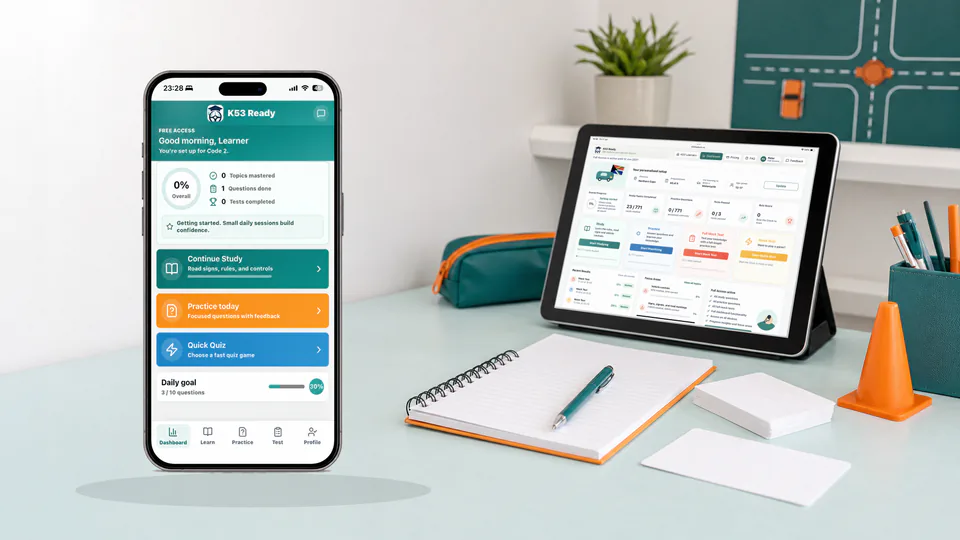
K53 Ready groups preparation around the same big areas: rules, signs, and vehicle controls. A mixed mock helps you practise switching between them, while the Results and wrong-answer review help you see which section needs the next short session.
Use the app to build a repeatable loop: study a small topic, answer questions, check the explanation, and try again later. K53 Ready is not the official test and cannot guarantee a pass, but it can make your weak area easier to spot before test day.
Keep the official sources close
Use the NaTIS learner-driver manuals for the source material behind rules, road traffic signs, and vehicle controls. Use your DLTC for final booking, document, venue, fee, and test-format details.
The pass marks are useful because they turn a vague goal into three clear checks. Just do not stop at the minimum. A small practice buffer and honest mistake review are much calmer than hoping the combined total will carry you.