Know why vehicle controls are tested
The South African Government learner's licence guidance says you must study road signs, motor vehicle controls, and road rules before you write. Western Cape Government guidance also lists rules of the road, road markings, road signs, and the controls of a vehicle as preparation areas.
That means vehicle controls are not a side topic. They are one of the official knowledge areas. The test is checking whether you understand the parts of the vehicle you would use to control, signal, slow down, stop, see, and keep the vehicle safe.
Do not ignore the small section
The vehicle controls section is smaller than the road signs and rules sections, but small does not mean optional. A government gazette notice on learner's licence test requirements lists the required minimum marks as 22 for rules of the road, 23 for road traffic signs, and 6 for the controls of the vehicle.
The practical lesson is simple: you cannot only study signs and hope the controls section looks after itself. Give vehicle controls its own short revision slot so you are not guessing under pressure.
Learn controls as actions, not as loose words
A useful way to study vehicle controls is to group them by the job they do. Instead of staring at a long list, ask: what would I use this control for?
- To steer: steering wheel or handlebars, depending on the code.
- To slow or stop: brakes, and the correct way to control speed.
- To move or change speed: accelerator, clutch, gear lever, or the relevant motorcycle controls.
- To signal or be seen: indicators, lights, hooter, and warning controls.
- To see clearly: mirrors, windscreen controls, and demisters where relevant.
This turns the section into real driving thinking. You are not just memorising a label. You are connecting the control to the action a safe driver would need.
Match the controls to your learner code
Your learner code matters. Code 1, Code 2, and Code 3 do not all point to the same vehicle. The government guidance describes Code 1 for motorcycles and similar vehicles, Code 2 for light vehicles up to 3 500 kg, and Code 3 for heavier vehicles.
So do not study vehicle controls as if every learner is preparing for the same machine. If you are writing for a motorcycle, make sure your controls thinking matches a motorcycle. If you are writing for a light vehicle, focus on the controls and dashboard items a light-vehicle learner must understand.
Use K53 Ready to test the weak spots
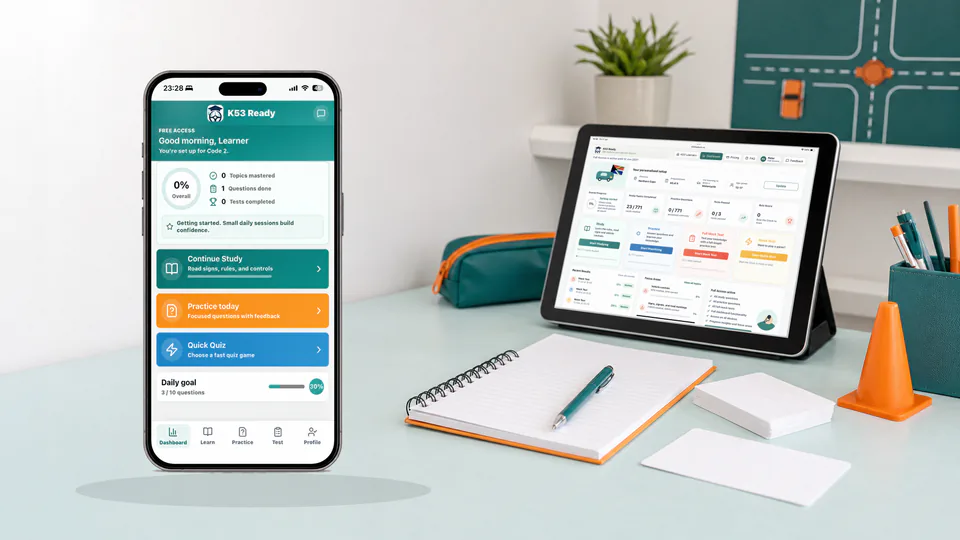
Start with a short Study pass so the control names and actions feel familiar. Then move into Practice so you can see whether you actually understand the questions.
If you miss a vehicle-control question, do not just remember the correct option. Ask why the other options were wrong. Was it a steering question, a braking question, a visibility question, or a dashboard-control question? That label tells you what to revise next.
K53 Ready is a study and practice tool, not an official government service and not a pass guarantee. Use official sources for final requirements, and use K53 Ready to build steadier practice habits.
Try this simple vehicle-controls session
If you have 20 minutes, use it like this:
- 5 minutes: scan the main controls for your learner code.
- 5 minutes: group them by action: steer, stop, move, signal, see.
- 5 minutes: answer a small set of practice questions.
- 5 minutes: review only the questions you got wrong or guessed.
Repeat that a few times during the week. Vehicle controls usually feel easier when you revisit them in small pieces instead of trying to cram them after a full road-sign session.